The 21st Century’s Unique Challenges to Democracy
A Research Hub and Bibliography
The twenty-first century presents unique challenges to the democratic form of government. Here you will find what some of those issues are, with context and resources.


Where it happens
Your street
Neighborhood meetings, tenant and parent groups, a petition to the city. Most people’s first act of self-government is here.
Your town
City councils, school boards and municipal governments meet in public. Anyone can attend, and most allow public comment.
Your state
State legislatures decide who can vote and how districts are drawn. Your representatives there have offices that answer calls and letters.
Your country
National elections, courts and a free press, and the rights to speak, gather and petition that let people hold all three to account.
Between countries
Treaties, international courts and election observers. Democracies keep each other honest, or fail to.
Luminaries
Democracy in Action
Each month, discover the story of an individual who has shown us how to “do” democracy, and why it was important to them.
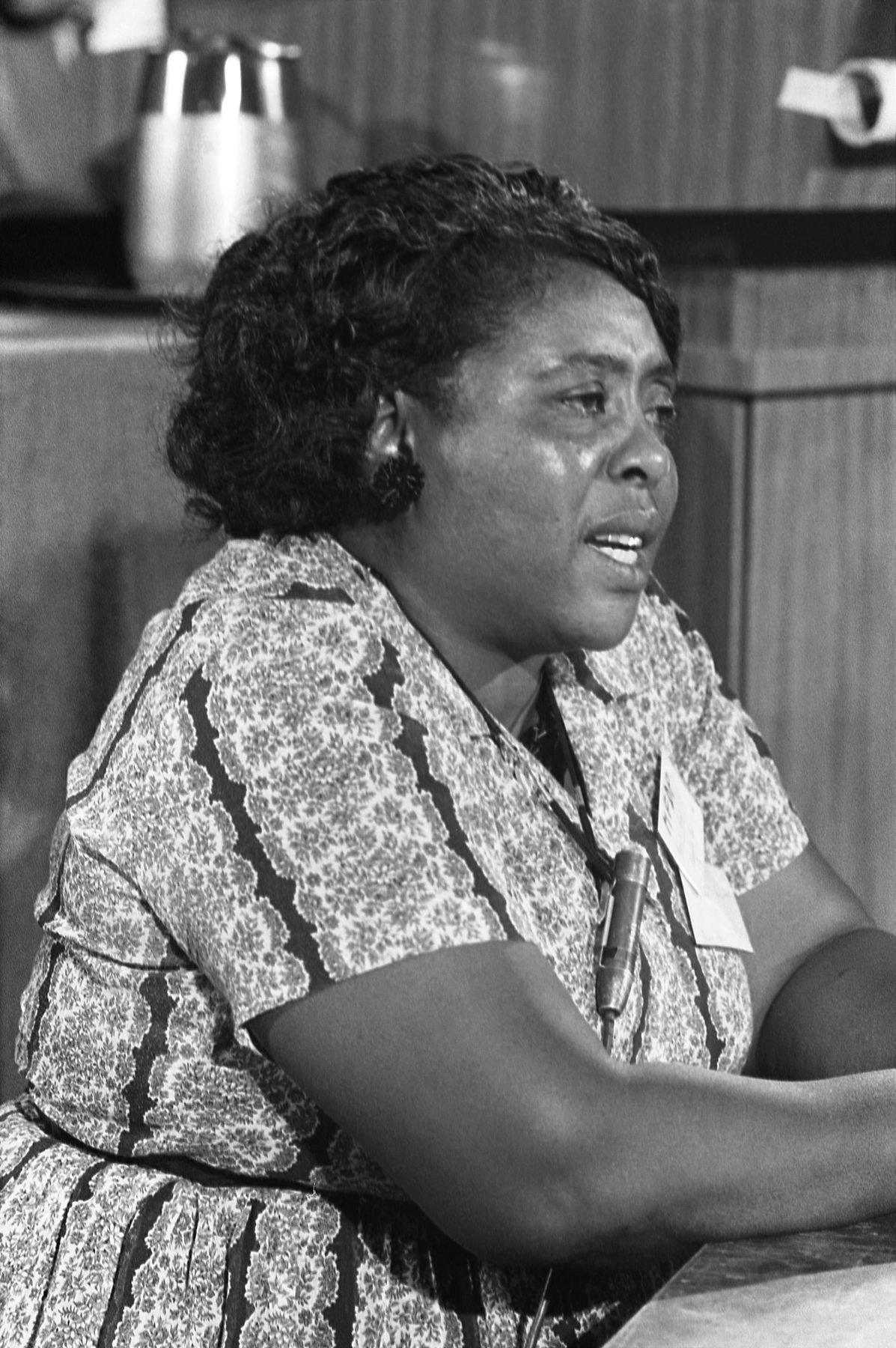
Fannie Lou Hamer at the 1964 convention
A sharecropper from Mississippi lost her job and her home for trying to vote. Two years later she told the country what it had cost her.
Democracy: A Timeline
How people won the right to govern themselves, and what stood in their way each time. On the right, the thinkers and writers who shaped how we understand it.
- Before 2000 BCE
Assemblies before kings
The challenge: Power was settling into the hands of kings.
The historian Thorkild Jacobsen argued in 1943 that the earliest Sumerian cities settled big questions in assemblies of free men and elders, before kingship took over. Not every scholar agrees, but it is a reminder that people governed themselves in councils long before anyone used the word democracy.
- 594 BCE
Solon cancels debt slavery
The challenge: Poor Athenians were being sold into slavery for unpaid debts, and the city was close to civil war.
Named archon to settle the crisis, Solon canceled debts secured on a person’s body and freed those enslaved for debt. He opened the assembly and the courts to the poorest citizens. It was not yet democracy, but it set the ground for it.
- c. 508 BCE
Cleisthenes and rule by the people
The challenge: After decades of tyranny, powerful families fought to take the city back.
Cleisthenes reorganized Athenians into ten new tribes that mixed people from the city, the coast and the inland, breaking the hold of the old clans. Citizens met in an assembly to make laws themselves. Women, enslaved people and foreigners were still shut out.
“Its administration favours the many instead of the few; this is why it is called a democracy.”
Pericles, c. 431 BCE
Athenian statesman, as recorded by Thucydides“The unexamined life is not worth living.”
Socrates, 399 BCE
Philosopher, at his trial before an Athenian jury, as recorded by Plato
The democracy he questioned sentenced him to death.“A charming form of government, full of variety and disorder, and dispensing a sort of equality to equals and unequals alike.”
Plato, c. 375 BCE
Philosopher, The Republic
A critic: he thought rule by the many led to tyranny.“Man is naturally a political animal.”
Aristotle, c. 350 BCE
Philosopher, Politics - 494 BCE
The plebeians walk out
The challenge: In the young Roman Republic, a small class of patricians held every office.
Roman tradition holds that the common people left the city in a mass walkout, the first secession of the plebs, until they won their own officials, the tribunes, who could block abuses by magistrates.
“Salus populi suprema lex esto.”
Cicero, c. 50s BCE
Roman statesman, On the Laws
Let the safety of the people be the highest law. - 1100s–1400s
The Haudenosaunee Great Law of Peace
The challenge: Long wars between neighboring nations.
Five nations, the Mohawk, Oneida, Onondaga, Cayuga and Seneca, joined in a confederacy under a constitution passed down orally, with a council of chiefs chosen by clan mothers. Historians still debate the date of its founding.
- 1215
Magna Carta
The challenge: A king who taxed and punished as he pleased.
Rebel barons forced King John to seal a charter saying no free man could be imprisoned or stripped of his rights except by lawful judgment of his peers or the law of the land. The pope annulled it within months, but it was reissued and became the root idea that even rulers are under the law.
- 1265
Towns come to Parliament
The challenge: Only great lords and bishops advised the crown.
Simon de Montfort called a parliament that included two representatives from each of a number of towns, alongside knights from the counties. It is often counted as the beginning of the House of Commons.
- 1689
The English Bill of Rights
The challenge: Kings who suspended laws and kept standing armies without consent.
After the Glorious Revolution, Parliament set terms for William and Mary: no taxes or standing army in peacetime without Parliament’s consent, free elections and free speech in Parliament.
“Men being, as has been said, by nature, all free, equal, and independent, no one can be put out of this estate, and subjected to the political power of another, without his own consent.”
John Locke, 1689
Philosopher, Second Treatise of Government - 1776
The Declaration of Independence
The challenge: Colonists taxed and governed by a Parliament where they had no vote.
The Declaration said governments get their “just powers from the consent of the governed” and that people have a right to alter or abolish one that destroys their rights. Its promise that “all men are created equal” was written by men who enslaved people, a contradiction later generations would use to demand it be kept.
“There is no liberty if the power of judging is not separated from the legislative and executive powers.”
Montesquieu, 1748
Philosopher, The Spirit of the Laws
Translated from the French.“Man is born free; and everywhere he is in chains.”
Jean-Jacques Rousseau, 1762
Philosopher, The Social Contract - 1787–1791
The Constitution and the Bill of Rights
The challenge: A weak confederation, and fear of a strong central government.
The Constitution divided power among three branches and between the states and the nation. The first ten amendments, ratified in 1791, protected speech, press, religion, assembly and the right to a fair trial.
“If men were angels, no government would be necessary.”
James Madison, 1788
The Federalist No. 51 - 1789
The Declaration of the Rights of Man and of the Citizen
The challenge: An absolute monarchy and a society of fixed ranks.
The National Assembly declared that people are born and remain free and equal in rights, and that sovereignty rests with the nation. It became a model for constitutions across Europe and Latin America.
“I do not wish them to have power over men; but over themselves.”
Mary Wollstonecraft, 1792
A Vindication of the Rights of Woman - 1832
The Great Reform Act
The challenge: “Rotten boroughs” with a handful of voters sent members to Parliament while new industrial cities had none.
After years of protest, Parliament redrew seats and widened the vote. Most men still could not vote, but the act opened a century of further reform.
“Town-meetings are to liberty what primary schools are to science; they bring it within the people’s reach, they teach men how to use and how to enjoy it.”
Alexis de Tocqueville, 1835
Democracy in America, tr. Henry Reeve - 1848
The Declaration of Sentiments
The challenge: Women had no vote and few legal rights.
At the first women’s rights convention, organizers rewrote the Declaration of Independence to say “all men and women are created equal” and called for the right to vote.
“This Fourth of July is yours, not mine. You may rejoice, I must mourn.”
Frederick Douglass, 1852
“What to the Slave Is the Fourth of July?”, Rochester - 1870
The Fifteenth Amendment
The challenge: Four million people freed from slavery after the Civil War, with no guarantee they could vote.
The amendment barred denying the vote on account of race, color or previous condition of servitude. Within a generation, Southern states used poll taxes, literacy tests and violence to take that right away again.
“That government of the people by the people for the people, shall not perish from the earth.”
Abraham Lincoln, 1863
Gettysburg Address“It was we the people—not we white male citizens—nor yet we male citizens—but we the whole people, who formed this Union.”
Susan B. Anthony, 1873
“Is It a Crime for a U.S. Citizen to Vote?” - 1893
Women vote in a national election
The challenge: No self-governing country let women vote in national elections.
After petitions signed by tens of thousands of women, New Zealand became the first self-governing country to give women the vote in national elections.
- 1920
The Nineteenth Amendment
The challenge: Seventy years of campaigning for women’s suffrage.
The amendment barred denying the vote on account of sex. Many women of color still could not vote because of the same barriers that kept Black men from the polls.
- 1948
The Universal Declaration of Human Rights
The challenge: A world just out of a war started by dictatorships.
Article 21 says that “the will of the people shall be the basis of the authority of government,” expressed in periodic and genuine elections by universal and equal suffrage and secret vote.
“It has been said that democracy is the worst form of Government except all those other forms that have been tried from time to time.”
Winston Churchill, 1947
House of Commons - 1950
Universal suffrage from the start
The challenge: A newly independent country of hundreds of millions, most of whom could not read.
India’s constitution gave every adult the vote at once. In the first general election, held 1951–52, parties used picture symbols on the ballot so that people who could not read could still choose.
“Political democracy cannot last unless there lies at the base of it social democracy.”
B. R. Ambedkar, 1949
Chair of the drafting committee, India’s Constituent Assembly - 1953
Women win the federal vote
The challenge: Decades of campaigning after the 1917 Constitution left women out.
On October 17, 1953, a reform to the Constitution recognized women as full citizens with the right to vote and run for office at the federal level. Women voted in a federal election for the first time in 1955.
- 1965
The Voting Rights Act
The challenge: Literacy tests, poll taxes and violence that kept most Black Southerners from voting.
After the marches from Selma to Montgomery, Congress banned literacy tests and sent federal examiners to register voters. Black registration in the South rose sharply within a few years.
“Give us the ballot, and we will no longer have to worry the federal government about our basic rights.”
Martin Luther King Jr., 1957
“Give Us the Ballot,” Washington - 1989
The Berlin Wall falls
The challenge: One-party states held in place by the Soviet Union.
Peaceful mass protests in Poland, East Germany, Czechoslovakia and elsewhere brought down communist governments, and free elections followed.
“Living within the truth.”
Václav Havel, 1978
Playwright, “The Power of the Powerless”
His phrase for ordinary people refusing to repeat what they knew to be lies. - 1994
The first democratic election
The challenge: Apartheid, which denied the vote to the Black majority.
On April 27, 1994, South Africans of every race voted together for the first time. Nelson Mandela was inaugurated president on May 10.
“I have cherished the ideal of a democratic and free society in which all persons live together in harmony and with equal opportunities.”
Nelson Mandela, 1964
Statement from the dock, Rivonia Trial - Now
The twenty-first century
The challenge: New tools for persuasion and control, and old rights under new pressure.
The challenges on this page, from AI to the media to civil rights, are the ones this generation has to meet.
Democracy & AI · Democracy & Media · Democracy & Civil Rights
Sources for the timeline and the quotations
- World History Encyclopedia, “Timeline: Democracy”
- Encyclopaedia Britannica, “Democracy”
- Thorkild Jacobsen, “Primitive Democracy in Ancient Mesopotamia,” Journal of Near Eastern Studies 2, no. 3 (1943): 159–172
- U.S. National Archives, “Magna Carta”
- UK Parliament, “The Bill of Rights”
- U.S. National Archives, “Declaration of Independence”
- Élysée, “The Declaration of the Rights of Man and of the Citizen”
- UK Parliament, “The Reform Act 1832”
- National Park Service, “Report of the Woman’s Rights Convention”
- U.S. National Archives, “15th Amendment”
- NZHistory, “Women and the vote”
- U.S. National Archives, “19th Amendment”
- United Nations, “Universal Declaration of Human Rights”
- Gobierno de México, “Línea del tiempo: mujeres y la Constitución”
- U.S. National Archives, “Voting Rights Act (1965)”
- South African History Online, “South Africa’s first democratic elections”
- Thucydides, History of the Peloponnesian War, tr. Richard Crawley (Project Gutenberg)
- Plato, Apology, tr. Benjamin Jowett (Project Gutenberg)
- Plato, The Republic, Book VIII, tr. Benjamin Jowett (Project Gutenberg)
- Aristotle, Politics, Book I, tr. William Ellis (Project Gutenberg)
- Cicero, De Legibus III.8 (The Latin Library)
- John Locke, Second Treatise of Government, sec. 95 (Project Gutenberg)
- Montesquieu, De l’esprit des lois, XI.6 (Project Gutenberg)
- Rousseau, The Social Contract, I.1, tr. G. D. H. Cole (Project Gutenberg)
- The Federalist Papers, No. 51 (Project Gutenberg)
- Mary Wollstonecraft, A Vindication of the Rights of Woman (Project Gutenberg)
- Alexis de Tocqueville, Democracy in America, vol. 1, ch. 5, tr. Henry Reeve (Project Gutenberg)
- Frederick Douglass, My Bondage and My Freedom, appendix (Project Gutenberg)
- Abraham Lincoln, Gettysburg Address, Nicolay copy (Library of Congress)
- Susan B. Anthony, “Is It a Crime for a U.S. Citizen to Vote?” (Voices of Democracy, University of Maryland)
- Hansard, House of Commons, 11 November 1947, Parliament Bill
- B. R. Ambedkar, Constituent Assembly of India, 25 November 1949
- Martin Luther King Jr., “Give Us the Ballot” (King Institute, Stanford)
- Nelson Mandela, statement from the dock, 20 April 1964 (Nelson Mandela Foundation)