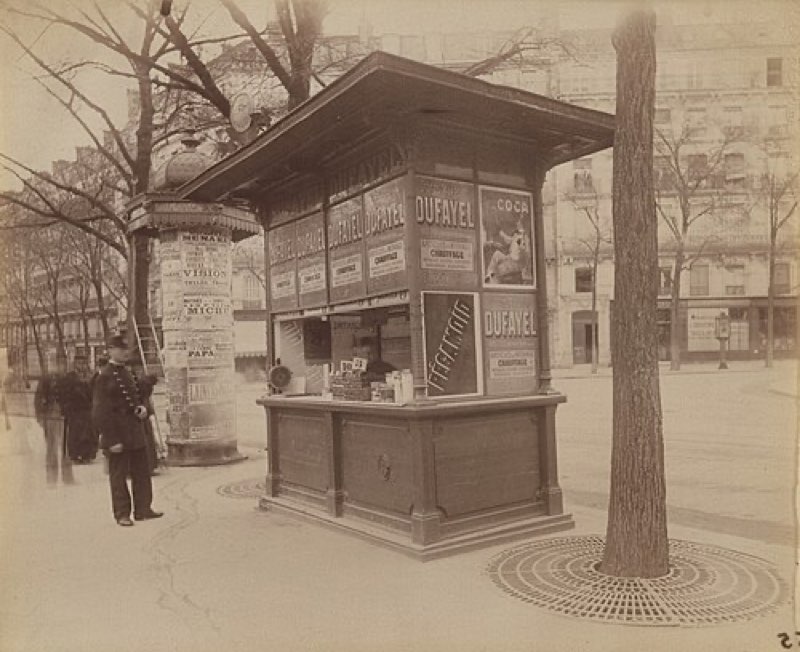
Eight questions about the book, four about the whole of it and four about single chapters. Each one is answeredfour ways, through a literary theory or an idea from philosophy, sociology, psychology or religion.
The answers don’t always agree. Some theories open a question up and some have little to say about it, and each answer says which. Swipe or use the arrows to move between them.
Is it a memoir if he says you can read it as fiction?
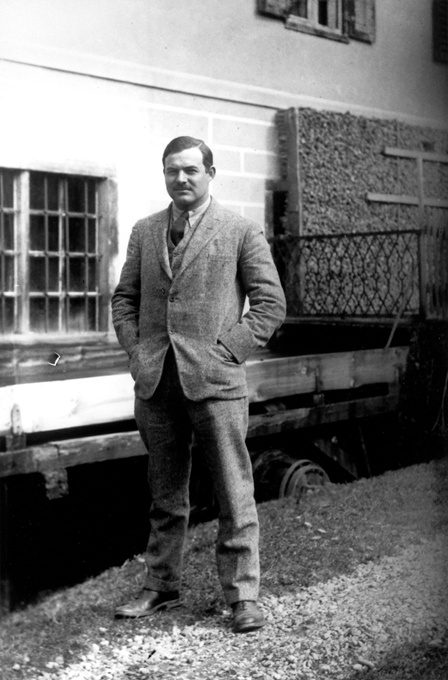
1924, unknown photographer, public domain
Hemingway wrote the book between 1957 and 1960, more than thirty years after the years it covers, 1921 to 1926. It came out in 1964, three years after his death, prepared by his widow, Mary. His preface ends: “If the reader prefers, this book may be regarded as fiction. But there is always the chance that such a book of fiction may throw some light on what has been written as fact.”
The autobiographical pact
What promise does a book make that its author, narrator and main character are one person?
For Philippe Lejeune, an autobiography is defined less by its accuracy than by a contract: the name on the cover is the name of the “I” inside. A Moveable Feast keeps that contract everywhere. Stein and Sylvia Beach call the narrator Hemingway, his wife is Hadley, his son is Bumby.
Then the preface offers to cancel the contract, but only “if the reader prefers.” It doesn’t say the book is fiction. It hands the choice to us. Lejeune gives you a name for what the preface does: it keeps the authority of a memoir and steps away from the responsibility.
Opens a lot here
Where it falls short. It tells you what kind of book this is, not whether any scene happened.
Philippe Lejeune, “The Autobiographical Pact” (1975)
New Historicism
How did the text get made, and how does it sit beside the other records of its time?
The book we read was put together after Hemingway died in July 1961. Mary Hemingway and the editors at Scribner’s settled the order of the chapters and worked from drafts he hadn’t finished. In 2009 his grandson Seán Hemingway published a Restored Edition with a different arrangement and sketches the first edition left out. What “Hemingway meant” depends partly on which edition you hold.
A historical reading also sets the book beside other accounts of the same people. Gertrude Stein had already told her version of Hemingway in The Autobiography of Alice B. Toklas (1933), and it is not kind to him. A Moveable Feast reads differently once you know it is, in part, a reply.
Opens a lot here
Where it falls short. It can turn the book into a puzzle about manuscripts and leave the writing behind.
Seán Hemingway, introduction to A Moveable Feast: The Restored Edition (2009)
Deconstruction
Where does the text undo what it claims?
Paul de Man argued that every autobiography gives a face and a voice to someone who is gone, and in doing so hides that he is gone. Hemingway, near sixty, writes as a man in his twenties, and the young man keeps knowing things he couldn’t have known yet: which painter will hang himself, which friend will fall apart, how the marriage ends.
The last paragraph says the book shows “how Paris was in the early days.” A few lines earlier it says the memory of each person who has lived in Paris “differs from that of any other.” In the same paragraph, the book claims to be a record and admits it can’t be one.
Some light
Where it falls short. It makes every memoir equally impossible, which doesn’t help you tell this one from any other.
Paul de Man, “Autobiography as De-facement” (1979)
New Criticism
What do the words on the page do, apart from the author’s life?
A New Critic would set the question aside. Whether Hemingway really sat in that café doesn’t change how the sentences work, and the book should be read for its images, its repetitions and its tone. That is a good discipline for the chapters themselves.
On this question, though, it has little to say. The preface asks us outright how to take the book, and nearly every page is about real, named people. Ignoring the question means ignoring something the book is doing on purpose.
Little to work with
Where it falls short. This is the one question it refuses to ask.
W. K. Wimsatt and Monroe Beardsley, “The Intentional Fallacy” (1946)
2 · The whole book
Why does being poor look so good?
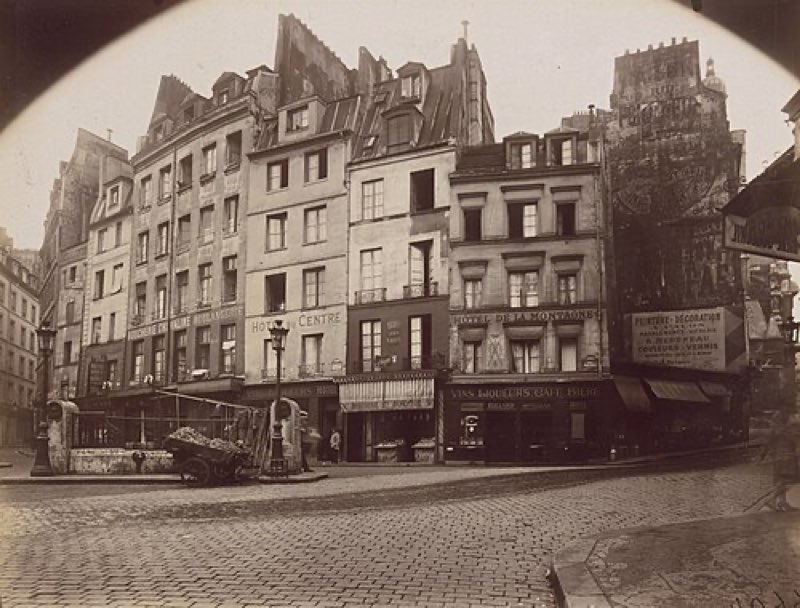
Eugène Atget, 1925, public domain
The book ends: “But this is how Paris was in the early days when we were very poor and very happy.” Along the way he skips lunch, wears sweatshirts for underwear to keep warm, and tells himself that “Hunger is good discipline.” He and Hadley also ski in Austria, bet on the horses at Auteuil and save up for the feria at Pamplona.
Marxist criticism
Who pays, who works, and how does the text hide it?
The book’s poverty is chosen and temporary, which makes it different from the poverty of the people around them. Their quarter is full of drunks, cesspools emptied by pump, and a goatherd who milks a goat into a neighbor’s pot on the sidewalk. The narrator sees these people mostly as part of the scene.
A Marxist reading would call this the ideology of bohemia: a class position, an educated American with prospects, presented as a virtue, simplicity and discipline. “Very poor and very happy” works because it lets money drop out of the story while it was there all along.
Opens a lot here
Where it falls short. It can flatten the real, daily discipline of the work into a pose.
Terry Eagleton, Marxism and Literary Criticism (1976)
Field theory
How do artists earn prestige, and what do they give up for it?
Pierre Bourdieu described the literary world as “the economic world reversed”: the less a writer seems to want money, the more prestige he gathers, and the prestige can later turn into money. A Moveable Feast is close to a manual for this.
When Fitzgerald explains how he rewrites good stories to sell them to the magazines, Hemingway tells him it is “whoring.” He says he should never have read his work to the rich if he’d been “functioning as a professional.” The book was written by a Nobel laureate looking back at the years when he built up the standing that made him one. In that light, the poverty was an investment.
Opens a lot here
Where it falls short. It reads every choice as strategy, which leaves no room for the plain love of the work the book also shows.
Pierre Bourdieu, “The Field of Cultural Production, or: The Economic World Reversed” (1983)
Feminist criticism
Whose voice, work and point of view does the text center, and whose does it use?
Much of what kept the household going was Hadley’s: income from a trust fund her family left her. In the book she is “my wife” about twice as often as she is Hadley. The narrator presents going without as his own discipline, but the costs fall on her too. He admits that she went without clothes so they could buy pictures.
Read this way, “we were very poor” is one person speaking for two, and the person whose money made the poverty bearable never gets to tell it.
Opens a lot here
Where it falls short. Hadley’s side has to be brought in from outside the book, from letters and biographies.
Gioia Diliberto, Hadley (1992)
Kantian aesthetics
Can beauty be enjoyed without wanting anything from it?
Kant called the judgment of beauty “disinterested”: a pleasure that doesn’t depend on owning or using the thing. Hemingway’s hungry walks come close to this. He can’t buy anything, so he looks. The paintings and the river are his without being possessed. Kant helps explain why the poverty feels like a kind of purity.
But the book keeps breaking the frame. He studies Cézanne to take something for his own writing, he tells the girl in the café that she belongs to him, and he is always counting francs. Disinterest is the ideal the book reaches for, not the life it describes.
Some light
Where it falls short. Useful as a contrast, not as a key.
Immanuel Kant, Critique of Judgment (1790), sections 2–5
3 · The whole book · Stein, Ford, Pound, Fitzgerald and others
What are the portraits of other writers doing?
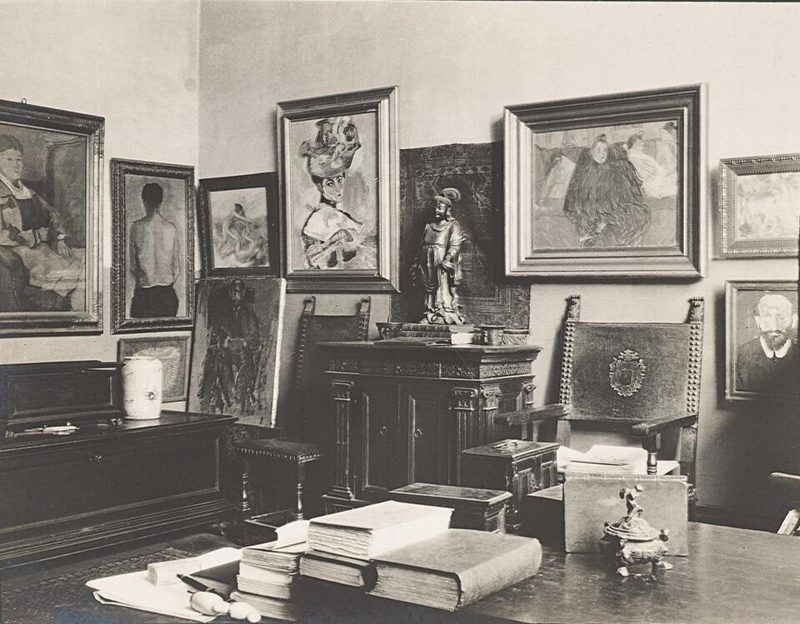
About 1906, unknown photographer, public domain
Many chapters are portraits. Ezra Pound comes off as generous and Sylvia Beach as kind. Gertrude Stein, Ford Madox Ford, Wyndham Lewis and Scott Fitzgerald come off as vain, foolish or weak. Those four were all dead by the time he started writing, and none of them could answer.
The anxiety of influence
How do writers make room for themselves against the writers who formed them?
Harold Bloom argued that strong writers have to overcome the writers who formed them, and do it by misreading them. Stein taught Hemingway a great deal about repetition and the plain sentence. Fitzgerald helped bring him to Scribner’s. These are the two the book treats most harshly.
Chapters that could have been thank-you notes come out as corrections. Stein becomes a talker who wouldn’t do the work of cutting, and Fitzgerald a talent wasted. Bloom’s idea explains why the debt comes out as contempt.
Opens a lot here
Where it falls short. Bloom is about poets and their poems. Here the rivalry plays out in gossip, and some of it is just settling scores.
Harold Bloom, The Anxiety of Influence (1973)
Recognition theory
What happens when people need to be seen and valued and aren’t?
Axel Honneth describes three kinds of recognition people need: love, respect as an equal, and esteem for what they contribute. The book is full of scenes where esteem is given, held back or demanded.
Stein tells him he isn’t good enough to be published in the Atlantic Monthly. Alice Toklas “always talked to the wives” so the men could talk. Hadley remembers a walking trip with their friend Chink and says, “It wasn’t like being a wife at Miss Stein’s.” And the young man is fighting to be taken seriously as a writer at all. The portraits read as the older man’s late ruling on who was recognized and who did the recognizing.
Opens a lot here
Where it falls short. It can make every hostile portrait sound like a wound, when some of them are simply funny.
Axel Honneth, The Struggle for Recognition (1992)
Mimetic desire
Do we want things because someone close to us wants them?
René Girard argued that desire is borrowed: we want what our models want, and the closer the model, the more admiration turns into rivalry. Hemingway and Fitzgerald want the same thing, the great novel, from the same publisher, in the same city, and the friendship turns as they compete.
The triangles multiply. In “Hawks Do Not Share,” Zelda is jealous of Scott’s work, and the narrator is plainly jealous of Zelda’s hold on Scott. At the end of the book the pattern comes home, when a young woman becomes the wife’s “temporary best friend” and then sets out to marry the husband.
Opens a lot here
Where it falls short. It is strongest on Fitzgerald and weak on the minor portraits, where there is no rivalry to speak of.
René Girard, Deceit, Desire and the Novel (1961)
Queer theory
How does the text handle desire that doesn’t fit the expected pattern?
Two Stein chapters turn on sex. In “Miss Stein Instructs,” she tells him that what male homosexuals do is “ugly and repugnant,” while “in women it is the opposite.” In “A Strange Enough Ending,” he overhears Alice Toklas speaking to Stein as he “had never heard one person speak to another,” and Stein pleading with her. He leaves, and the friendship never recovers.
A queer reading notices that the book ends his friendship with Stein over a glimpse of her private life with Alice, and that the narrator who is so shocked has spent pages reporting it. Eve Sedgwick’s work on bonds between men would also look hard at the Fitzgerald chapters.
Opens a lot here
Where it falls short. It can drift into guessing about Hemingway’s private life, which the text doesn’t settle.
Eve Kosofsky Sedgwick, Between Men (1985)
4 · The whole book · “A False Spring,” “There Is Never Any End to Paris”
What is lost, and who does he blame?
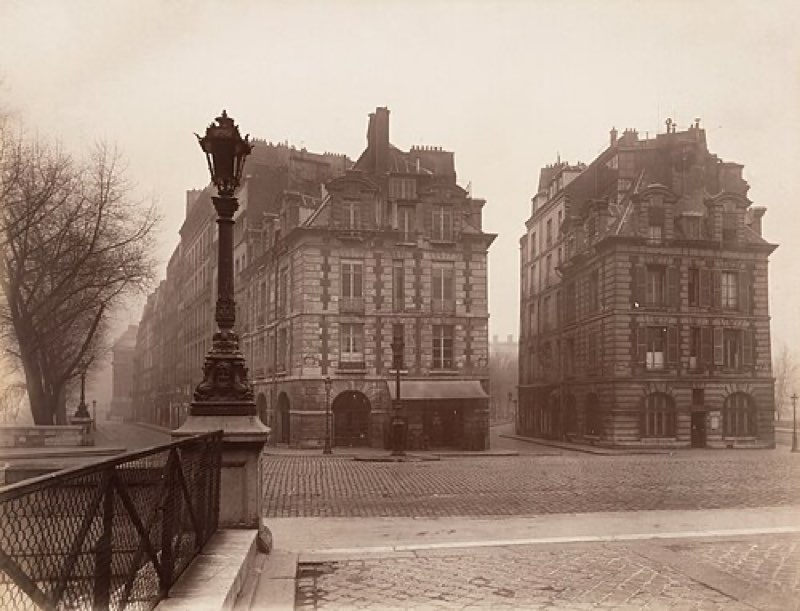
Eugène Atget, 1925, public domain
In “A False Spring,” Hadley tells him, “Memory is hunger.” The last chapter moves from a winter of skiing in the Vorarlberg to “the rich” and their “pilot fish,” and to a young woman who “unknowingly, innocently and unrelentingly sets out to marry the husband.” Seeing his wife waiting at the station, he writes, “I wished I had died before I ever loved anyone but her.”
Psychoanalytic criticism
What does the text do with a wish or a loss it can’t face directly?
Freud separated mourning, which lets go of a lost person bit by bit, from melancholia, where the loss is kept inside and turns into reproach of the self. The book was written thirty years after the divorce from Hadley, by a man on his fourth marriage, and it keeps returning to her as the measure of happiness.
It doesn’t let go. Paris and Hadley are fused, and the tenderness toward both is also a way of punishing the man who left.
Opens a lot here
Where it falls short. It turns the book into a symptom and the sentences into evidence.
Sigmund Freud, “Mourning and Melancholia” (1917)
Christian reading
What does the story share with scripture and Christian practice?
The last chapter has the shape of Genesis. There is a garden, the snowed-in valley where “I thought we were invulnerable again.” Tempters arrive: the pilot fish, then the rich, then the young woman. And it ends in an expulsion: “Paris was never to be the same again.”
Hemingway grew up in a churchgoing family in Oak Park, and the book itself mentions that he balanced Stein’s “lost generation” with a line from Ecclesiastes in his first novel. He knew these shapes. The Fall also explains what is evasive here: in Eden, the serpent takes much of the blame.
Opens a lot here
Where it falls short. The pattern can flatter the narrator, who gets cast as the tempted rather than the one who chose.
Genesis 3; Northrop Frye, The Great Code (1982)
Existentialism
Where does a person deny his own freedom so he won’t have to answer for it?
For Sartre, bad faith is the lie we tell ourselves that we had no choice. The last chapter is a case study. The rich follow a pilot fish, the young woman acts “unknowingly, innocently,” and the husband is carried along. Nearly every active verb belongs to someone else.
Only once does the narrator turn it on himself: the girl he was in love with was in Paris, and “I did not take the first train, or the second or the third.” That sentence is the book’s admission, and existentialism helps you see how little room it gets.
Opens a lot here
Where it falls short. It judges the narrator but says little about why the writing is so moving.
Jean-Paul Sartre, Being and Nothingness (1943), part one, chapter two
Reader-response
What does the reader bring, and what does the text leave for the reader to fill in?
The last paragraph nearly states this theory itself: the memory of each person who has lived in Paris “differs from that of any other,” and “you received return for whatever you brought to it.” A reader who has lost a first love or left a city brings that to the ending, and the book counts on it.
Wolfgang Iser called these places “gaps,” left open for the reader to fill. The biggest gap here is the affair itself, which the book never shows. It is only “the other thing.”
Some light
Where it falls short. It explains why the ending moves so many people, but not whether what they fill in is fair to Hadley or to Pauline.
Wolfgang Iser, The Act of Reading (1976)
5 · Chapter 1 · “A Good Café on the Place St.-Michel”
What does a writer need in order to work?
Eugène Atget, 1898, public domain
A cold, wet day drives him from his room to a café. He writes a story set in Michigan on a day as wild as the one outside, watches a girl at another table, and thinks: “I’ve seen you, beauty, and you belong to me now, whoever you are waiting for and if I never see you again.” When he finishes the story and looks up, she has gone.
New Criticism
What do the words on the page do, apart from the author’s life?
Close reading pays off here. The chapter moves from bad weather to shelter to work and then to appetite, oysters and white wine and a plan to leave Paris. The weather outside becomes the weather in the story: “it was that sort of day in the story.” The world is turned into material.
Look at the sentence about the girl: “You belong to me and all Paris belongs to me and I belong to this notebook and this pencil.” Ownership runs one way until the last clause turns it around. He owns the city only because the work owns him.
Opens a lot here
Where it falls short. It sees how the chapter is built but has nothing to say about why the scene is staged as possession.
Cleanth Brooks, The Well Wrought Urn (1947)
The poetics of space
How do rooms and shelters shape the imagination?
Gaston Bachelard wrote about the house as a shelter for daydreams, and about the corners and nests where the imagination feels safe. The café works this way. He hangs his old waterproof up to dry, orders a café au lait, takes out a notebook and pencil. A public room becomes, for an hour, his own.
The book keeps finding these shelters: the cold room at the top of the hotel where Verlaine died, the Closerie des Lilas, the inn at Schruns. Bachelard helps explain why so many readers come away remembering the rooms.
Opens a lot here
Where it falls short. Bachelard writes about private houses. The café is public and full of strangers, and that tension needs other tools.
Gaston Bachelard, The Poetics of Space (1958)
Feminist criticism
Whose voice, work and point of view does the text center, and whose does it use?
Laura Mulvey’s term “the male gaze” describes how a camera, or a narrator, makes a woman into something to be looked at. The girl in the café never speaks and is never named. She is described in parts: a face “fresh as a newly minted coin,” hair “black as a crow’s wing.” She belongs to him “whoever you are waiting for.”
Then she is used to fuel the story and forgotten. You don’t have to call the scene sinister to see what it does. The scene that shows how he works turns a woman into a prompt.
Opens a lot here
Where it falls short. It can miss the narrator’s own sense, in the last clause, that he is the one who belongs to something.
Laura Mulvey, “Visual Pleasure and Narrative Cinema” (1975)
Ecocriticism
How does the text treat weather, land and the world that isn’t human?
Ecocriticism looks at how texts treat weather, land and animals. There is plenty of weather in this chapter: the wind stripping the leaves in the Place Contrescarpe, the rain against the green autobus, fall turning to winter.
But the weather is almost always a mood, or raw material for prose. By the end of the chapter the rain is “only local weather.” The theory gets thin answers here. It does better in the Schruns chapter, where snow and avalanches decide what people can do.
Little to work with
Where it falls short. In this chapter, nature is mostly a mood.
Cheryll Glotfelty and Harold Fromm, eds., The Ecocriticism Reader (1996)
6 · Chapter 3 · “Une Génération Perdue”
Was there a lost generation?
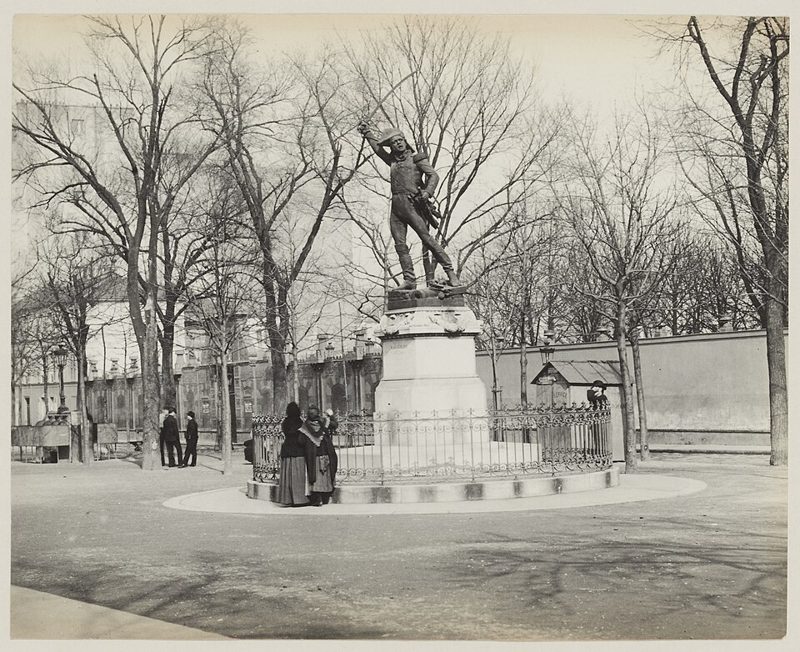
Hippolyte Blancard, about 1890, public domain
A young mechanic who served in the last year of the war does a poor job on Gertrude Stein’s Model T. His boss tells him, “You are all a génération perdue.” Stein turns it on Hemingway and his friends. Walking home past the statue of Marshal Ney, he decides “that all generations were lost by something and always had been and always would be.”
Generations
What makes people born around the same time into a generation?
Karl Mannheim argued that people born in the same years only become a generation when they share a formative event and answer it together. The war is the event here, and the chapter is an argument over who gets to name the answer. The garage owner coins the phrase, Stein applies it, and the veteran rejects it.
Hemingway’s answer, that every generation is lost by something, refuses Mannheim’s idea. The irony is that he had already made Stein’s phrase famous as an epigraph to The Sun Also Rises.
Opens a lot here
Where it falls short. It sees generations from the outside and can’t account for the private, physical memory the chapter hints at.
Karl Mannheim, “The Problem of Generations” (1928)
Trauma theory
How does a text carry an experience too large to be told straight?
Hemingway was badly wounded in Italy in 1918, and the war is almost never described in A Moveable Feast. It sits underneath this chapter. Walking home, he wonders if the young mechanic was ever “hauled in one of those vehicles when they were converted to ambulances,” and remembers them burning out their brakes on mountain roads. Then he stops by Marshal Ney, who fought in the rear guard on the retreat from Moscow.
Cathy Caruth argues that trauma comes back indirectly, attached to other scenes. Here it comes back as a statue, a drunk boss and a phrase.
Opens a lot here
Where it falls short. It can find hidden wounds everywhere. The chapter is also a funny, sharp argument between two writers.
Cathy Caruth, Unclaimed Experience (1996)
Marxist criticism
Who pays, who works, and how does the text hide it?
There is a class story inside the chapter. A wealthy American’s car isn’t fixed fast enough, the boss humiliates the young worker, and the American writer turns the insult into a slogan for her friends. Hemingway takes the boy’s side and guesses the boss “was probably drunk by eleven o’clock in the morning.”
A class reading shows that “lost generation” began as a boss’s insult to a worker before it became a label for writers.
Some light
Where it falls short. The mechanic has no name and a few lines. There isn’t much more to hold on to.
Terry Eagleton, Marxism and Literary Criticism (1976)
Critical race theory
Whose experience does the text treat as everyone’s, and who is left out?
The “generation” in this chapter is white and American, and nearly everyone in the book is too. Paris in the 1920s also had a well-known community of Black Americans, many of them veterans who had served in France. Eugene Bullard, who flew for France in the war, ran nightclubs in Montmartre.
Critical race theory would ask why the book’s Paris is so white, and who gets to count as “lost.” The question is fair. But the text gives it nothing to work with except the absence, and reading absences can say more about the reader than the book.
Little to work with
Where it falls short. The book gives it almost nothing but its silence.
Tyler Stovall, Paris Noir (1996); Toni Morrison, Playing in the Dark (1992)
7 · Chapter 8 · “Hunger Was Good Discipline”
Does hunger make better art?
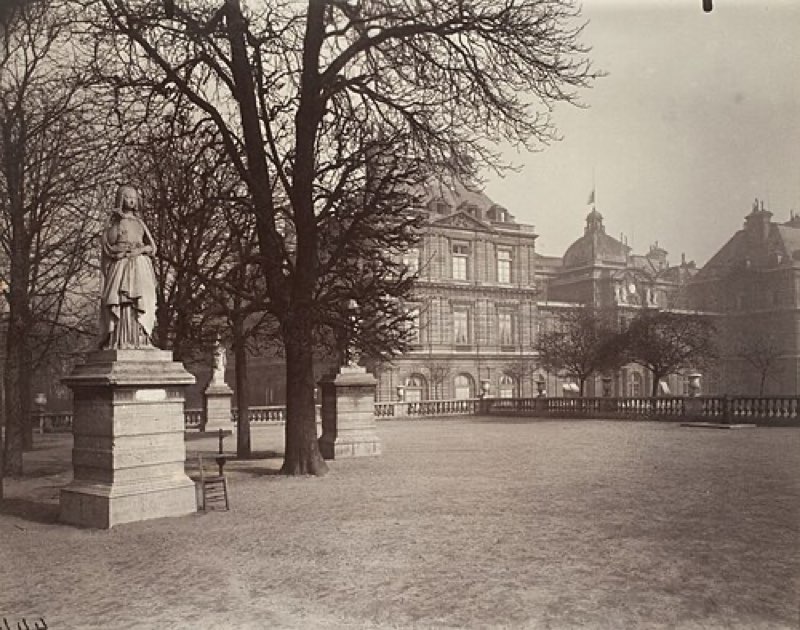
Eugène Atget, 1923–26, public domain
With no money for lunch, he walks routes that avoid the smell of food, and finds that the paintings in the Musée du Luxembourg are “sharpened and clearer and more beautiful if you were belly-empty, hollow-hungry.” The same chapter gives his theory of omission. He cut the real end of his story “Out of Season,” that the old man hanged himself, because “the omitted part would strengthen the story and make people feel something more than they understood.”
Phenomenology
How does the body shape what we see?
In “Cézanne’s Doubt,” Maurice Merleau-Ponty argues that Cézanne painted the world as it is first seen, before we sort it into objects. Seeing is done by a body, not a camera. Hemingway’s claim that he understood Cézanne better hungry fits this: the state of the body changes the painting.
He also says Cézanne was teaching him something that made “writing simple true sentences far from enough” to give his stories the “dimensions” he wanted. He is trying to do with sentences what Cézanne did with planes of color, and he says he couldn’t explain it to anyone.
Opens a lot here
Where it falls short. It explains the hunger and the looking, not whether the stories got better.
Maurice Merleau-Ponty, “Cézanne’s Doubt” (1945)
Reader-response
What does the reader bring, and what does the text leave for the reader to fill in?
The theory of omission is a theory of the reader. Wolfgang Iser said meaning happens in the gaps a text leaves open for the reader to fill. Hemingway puts it his own way: leave out the hanging and people will feel “something more than they understood.”
Hunger is a gap too. The chapter sets up a parallel: the empty stomach sharpens his eye the way the missing ending sharpens the reader’s. Then he jokes about his rejected stories: “now I have them so they do not understand them.”
Opens a lot here
Where it falls short. It accounts for the effect, but no reader of “Out of Season” could guess the hanging. Iser’s gaps are meant to be filled.
Wolfgang Iser, The Act of Reading (1976)
Christian reading
What does the story share with scripture and Christian practice?
In Christian practice, fasting trains the will and clears the mind for attention to God. Simone Weil wrote that schoolwork, done with real attention, is a preparation for prayer. Hemingway borrows the shape: “Hunger is good discipline and you learn from it.”
The goal is secular. The attention is for paintings and sentences. But the comparison shows how the book makes writing into a vocation with a rule of life: work in the morning, stop when you know what will happen next, don’t think about the story until you start again the next day.
Some light
Where it falls short. His hunger isn’t offered up to anything, and a sentence later he makes a joke of it: “I’m so far ahead of them now that I can’t afford to eat regularly.”
Simone Weil, “Reflections on the Right Use of School Studies with a View to the Love of God” (1942)
Marxist criticism
Who pays, who works, and how does the text hide it?
A Marxist reading would point out again that this hunger is chosen. In the same chapter, Sylvia Beach hands him six hundred francs from Der Querschnitt and he goes straight to Lipp’s for beer and potato salad.
That’s true, but it was already the point of the question about poverty, and here the chapter makes it against itself. The narrator knows the money is coming. A theory repeating what the text already admits isn’t adding much.
Little to work with
Where it falls short. It repeats the earlier question, and the chapter has already conceded the point.
Terry Eagleton, Marxism and Literary Criticism (1976)
8 · Chapters 17–19 · “Scott Fitzgerald,” “Hawks Do Not Share,” “A Matter of Measurements”
Why does Fitzgerald come off so badly?
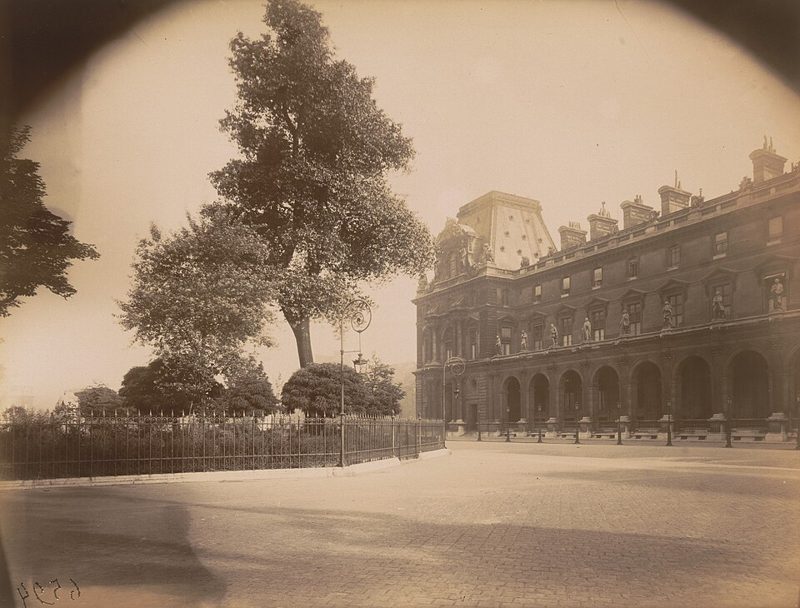
Eugène Atget, 1925, public domain
Three chapters near the end are about Scott Fitzgerald. On a trip to fetch the Fitzgeralds’ Renault from Lyon, Scott decides he is dying of “congestion of the lungs” and sends for a thermometer. Zelda, the book says, “was jealous of Scott’s work.” And Scott confides that Zelda told him “the way I was built I could never make any woman happy.” Hemingway checks in the lavatory, reassures him, and sends him to look at the statues in the Louvre.
The civilizing process
How do self-control and shame sort people into higher and lower?
Norbert Elias traced how Europeans learned, over centuries, to control their bodies and hide them, and how shame moved inward. The Lyon chapter is a comedy of self-control. Scott can’t hold his drink, imagines illnesses and demands a thermometer. The narrator keeps his temper, finds the waiter and pays.
The narrator’s ethic throughout the book is restraint: stop work when you know what happens next, don’t talk about it, drink in measure. Elias shows how the portrait ranks the two men on a scale of control, with Scott at the bottom.
Opens a lot here
Where it falls short. Elias describes changes across whole societies over centuries. One friendship is a small sample.
Norbert Elias, The Civilizing Process (1939)
Masculinity studies
How do men measure themselves against a model of manhood?
R. W. Connell’s idea of “hegemonic masculinity” describes the dominant version of manhood other men are measured against. “A Matter of Measurements” makes the measuring literal.
Scott’s worry is played as comedy, and the narrator is the steady man who checks, reassures and sends him to the Louvre. But the chapter needs Scott to be the lesser man so the narrator can be the greater one. It was written by an author who by then had spent decades building a public image of manhood.
Opens a lot here
Where it falls short. It reads the scene only as power and can miss that it is also a kindness.
R. W. Connell, Masculinities (1995)
Feminist criticism
Whose voice, work and point of view does the text center, and whose does it use?
Zelda is the villain of these chapters. She is jealous of Scott’s work, smiles when she knows he won’t be able to write, and tells him he is inadequate. The book gives her “hawk’s eyes” and almost no lines of her own.
Feminist critics have asked what her side looks like. She was a writer and painter. Her novel Save Me the Waltz (1932) drew on the same marriage Scott was turning into Tender Is the Night, and they fought over who owned that material. Sandra Gilbert and Susan Gubar wrote about the creative woman who is made to look mad. Zelda was in and out of hospitals from 1930 on, and the book reads her early behavior with that hindsight.
Opens a lot here
Where it falls short. Her side has to be imported from her own writing and biographies. The book doesn’t provide it.
Nancy Milford, Zelda (1970); Sandra Gilbert and Susan Gubar, The Madwoman in the Attic (1979)
New Historicism
How did the text get made, and how does it sit beside the other records of its time?
These chapters were written more than fifteen years after Fitzgerald died in 1940, and about a decade after Zelda died in a hospital fire in 1948. Neither could answer.
A historical reading sets the portrait beside the record: the letters between the two men, Fitzgerald’s help getting Hemingway to Scribner’s, and Hemingway’s earlier swipe in “The Snows of Kilimanjaro” (1936), which named “poor Scott Fitzgerald” until Fitzgerald objected and the name was changed. A Moveable Feast is the last move in a long rivalry, made when it was the only move left.
Opens a lot here
Where it falls short. It puts the portrait in context but can’t tell you whether the scenes happened as told.
Matthew J. Bruccoli, Fitzgerald and Hemingway: A Dangerous Friendship (1994)